Friday, October 2, 2015

October Math Workshop

OCTOBER MATH WORKSHOP
                             

In October, the second grade will be completing unit 2 (measurement) and begin our third unit. Unit 3 is a large unit and has many lessons. This unit will take us to the end of November.  


Unit 3 Place Value, Counting and Comparison of Numbers to 1,000
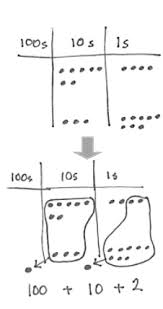
In this unit the children expand their understanding of units by bundling ones, tens, and hundreds up to a thousand.


Key Vocabulary: 

Standard Form: e.g. 576
 
Expanded Form: e.g. 576 =500 + 70 + 6

Word Form: e.g. Five hundred seventy-six

Unit Form: Stating the amount of hundreds, tens, and ones in each number, e.g., 11 is stated as 1 ten 1 one, 27 as 2 tens 7 ones, 100 as1 hundred, and 576 as 5 hundreds, 7 tens, 6 ones

Base-Ten Numeral: The idea that 1000 equals 10 hundreds, 100 equals 10 tens, and so on

Bundling: Putting smaller units together to make a larger one, e.g. putting 10 tens together to make a hundred

Regrouping: Renaming, (instead of “carrying” or “borrowing,”) e.g., a group of 10 ones is “renamed” a ten when the ones are bundled and moved from the ones to the tens place.


How you can help at home:
-Ask how many ones, tens, and hundreds are in numbers that you and your child come across
-Continue to review addition and subtraction skills.
-Help your child begin to compare numbers by asking questions about “more than”, “less than”, and “equal.”

Thursday, September 17, 2015

September Writing 2015

September Writing 2015


This month, we will be focusing on Summer Stories. The Summer Stories unit will focus on a moment over the summer that the students felt a strong emotion, such as excitement, pride, anger, etc.  In their Summer Story, the children will describe the event, their thoughts and 
feelings during the event, and why the student felt that it was an 
important event in their life.  The skills we will be focusing on during this writing unit include dialogue, three-step action, and inner thinking to make the writing more interesting and descriptive to an audience.


One way you can support your 2nd grade writer at home during this unit is by talking to them about strong emotions.  Children can describe times that they have felt a strong emotion, such as a time when they felt excited, angry, or proud. You can ask questions, such as “How did you feel when that happened?” or “What was it like when you felt proud, excited, etc.?”  Another way to support writers at home is by having students maintain a personal journal or diary at home to write about experiences in their life.  It can be a place for them to write down their ideas and thoughts, as well as a place to write creatively.

September Math Workshop


In September the second grade will be working on two units. The first unit focuses on adding and subtracting within 20. They will be using number bonds (fact families) to represent facts within 10.
For example:
   11 – 8 = 3
   /\
10  1

      10 – 8 = 2
      2 + 1 = 3
      11 – 8 = 3

The children will begin to use mental strategies for adding and subtraction within 20. They will use place value understanding to add and subtract within 20 by adding and subtraction from the ones. They will also learn strategies that will help them with adding and subtracting within 100. In addition to number sentences the children will be using addition and subtraction to solve one and two step word problems.
For example:
    2 + 4 = ____          6 – 4 = ____
        
  12 + 4 = ____         36 – 4 = ____
   /\                         /\
10  2                   30  6

  22 + 4 = ____         56 – 4 =           
   /\                         /\
20  2                   50  6

The
second unit focuses on measurement and how it is related to addition and subtraction. They will be using centimeter rulers and meter sticks to find the length of various objects. By measuring a variety of objects, the children will build a bank of known measurements or benchmark lengths (example: a doorknob is one meter from the floor or the width of a finger is a centimeter). They will measure and compare to figure out how much longer one object is than another using standard (centimeter ruler) and nonstandard (paper clips) units.